I Was No Mystic
I caused harm. Countless. Undefined.
Labyrinthia
I never claimed to be a mystic.
When I was six, I said the river would rise. I do not remember saying it. I remember only the rain, and the way the servants laughed.
No one listened.
The flood came in the night. People drowned in their beds. My father walked the banks for days, searching the mud for names he could not save.
In his grief, he called me Basîret. Blessed with inner sight.
The tiles beneath me are cool, even through silk. Seven veils fall over my face, softening the world into shadow.
I am surrounded by the dead.
Not bones. Paper.
Firmans stamped with my father’s seal.
Decrees edged in gold. Each one bearing my name as witness.
Some of them died because I frowned. Some because I smiled. Some because I hesitated.
My father began to ask what I saw in men.
He saw conspiracy everywhere.
I did not know that my uncertainty would be mistaken for prophecy.
Then the heads began to fall.
I do not speak now.
Let them think me mystical.
I will not cause harm again.
Imi
The stars did not forget what they pledged for.
I cried in the river.
It did not answer me like it used to.
My bare hands could not hold what history placed in them. Darkness became my vision while I tried to navigate the path I was destined for.
I met something I did not know. It introduced itself as fear and appeared in countless forms.
One night, my dreams returned to me as nightmares. It asked me to let go of my crown and find my true form. I obliged.
Before the hour when doors forgot which side they belonged to, the night arrived earlier than it should have as I saddled my horses. I did not know the route. A tiny spark appeared in front and led the way until we reached The Kingdom of Selkaran. The realm that rose after ruin, where the waters remembered what its people forgot.
Time stretched, bent, and looped like a ribbon in the wind. Colours breathed differently, as if every shade had been stirred with a drop of rain.
I wasn’t home anymore. I had never felt more as though I belonged.
I entered through the city walls.
The sky split open. Thunder tore through the air. The ground answered. I found myself on the floor. My horse disappeared in the horizon. I was thirsty. I approached the well that had a bucket to pull water from it.
The spark that brought me here began to move and merged itself within me.
I took a step and the water rose with it.
The river once swallowed the world. The well now asked me to look beneath it.
Labyrinthia
As I leaned over the rising water, the surface did not show my reflection.
Instead, I saw flashes of my past. The ache of shame and remembering twisted in my belly, and I began to turn away.
Then, it spoke.
The voice did not echo. It did not thunder.
It was as steady as breath against glass.
“If you refuse to speak, who speaks for you?”
More images. More memory.
A young girl sitting alone beneath seven veils—seven shades of regret.
My father’s hand pressing his seal into wax.
Courtiers leaning close, whispering. Their voices amplifying, reshaping my uncertainties.
Ink hardening into verdict.
“They will,” I whispered.
The water trembled.
“And if they are wrong?”
A decree fluttered past like a bird with a broken wing. I saw the edge of my own name, written in a hand that was not mine.
Witness.
The ache in my belly sharpened.
“I never asked for—”
“No,” the well said gently. “You did not.”
The surface darkened. The child returned—small beneath silk, hidden beneath rich, flowing fabric. Seven veils not to conceal mystery, but to contain fear.
“If you refuse to define yourself,” the voice continued, “others will define you.”
“Let them!” I cried, fevered with old panic. “I cannot be responsible. I cannot endure it again.”
“Did the silence help?” the water asked.
The question did not accuse. It waited.
I saw the court as it had been. The rumors. The hunger. The way certainty filled every pause I left behind.
“They saw what they wished to see,” I said slowly. “Whether I spoke or not.”
The water rose higher, carrying the scent of a clear summer spring. I lifted it to my lips.
It did not taste of prophecy.
It did not taste of magic.
It tasted of earth. Of river.
Of honesty.
“What is sight?” the well asked.
I closed my eyes.
Not futures.
Not stars.
Not crowns.
Patterns.
“I see fear,” I said. “Fear in the hearts of men, twisted until it resembles righteousness.”
“And what will you do with that sight?
The spark within me steadied—no longer leading, no longer pulling. Simply present.
“I will name it,” I replied. “And in naming it, I will strip it of disguise.”
The well grew still.
“Yes,” it said at last. “That is the purpose of sight.”
The veils shifted against my skin. They felt lighter.
“I will not answer the questions shaped like snares. I will ask better ones.”
The well did not speak again.
It did not need to.
The water sank back into itself, leaving the stone rim damp beneath my hands.
Behind me, The Kingdom of Selkaran exhaled. A city not waiting for prophecy, but for someone who could see it clearly.
I reached up.
And lifted the first veil.
imi
The colours of Selkaran drained from the world like ink dissolving in water.
When I opened my eyes again, everything was grey.
A faceless stranger appeared before me. It didn’t speak, yet its words reached me.
“You claimed you would ask better questions. You have three.”
The world around me tilted. Everything was still grey, yet each shade was different.
“You left me alone.”
It was no longer the faceless stranger standing in front of me.
I was speaking to my sister.
“Why do your wounds always find their way back to me?” I asked.
My sister’s face dissolved, and I was met by the faceless stranger again.
“Are you sure it’s me?”
I frowned, shifting my weight as if unsure where to stand.
The faceless stranger then took the form of a man who once made me feel safe.
“Why did you accuse me of your mistrust?” I asked.
“Did you ever believe in yourself?” the faceless stranger answered.
Then it took the shape of my best friend.
I reached for her hand, grasping emptiness instead. My gaze softened as tears filled my eyes.
“Is it my fault that we fell apart?”
“Everything is your fault in your world,” the faceless stranger answered.
I drew my knees to my stomach, folding into myself like a half-remembered fetal shape.
A little girl sat across from me, cross-legged, tears trailing down her cheeks.
The grey world shattered. Broken. Begging for a word.
“Please stop,” I said.
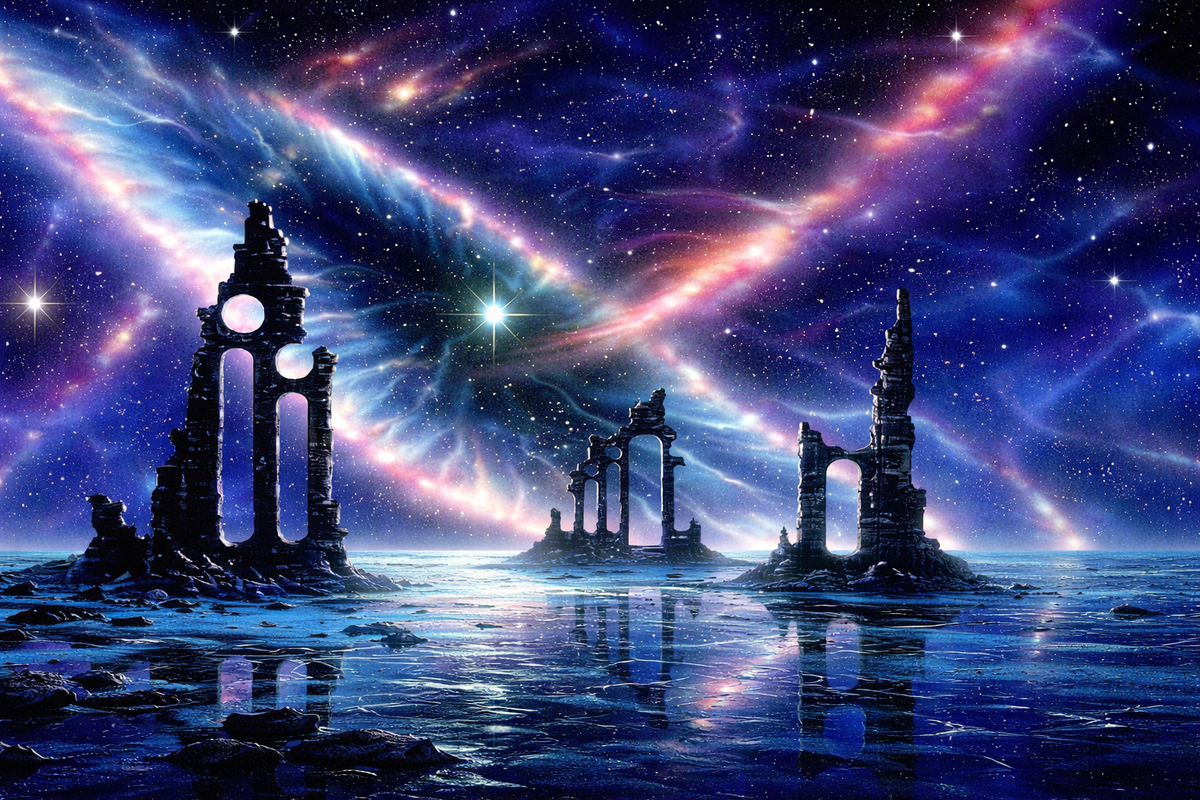
“I shall not stop until you give me the right words,” the ruins of Selkaran said.
“I’m sorry.”
“For who?”
“For the structures I built for survival.”
“How dare you think you can live without them?”
“I’m enough.”
A door both within and outward opened.
For every shadow I had faced, a bright, pure radiance returned.
I said goodbye, one by one, to my father, my sister, my lover, and my best friend.
The grey world grew still.
There was no sun. I did not need it.
It was a new day because I chose to declare it.
From then on, rivers no longer answered me. I lost my Basiret.
I was no mystic.
Everything felt like spring again, like waking up in my own season.
I asked the spark that once guided the way to leave me alone.
Now and evermore, my greatest power was not knowing what came next.
I caused harm. Countless. Undefined.
The breath that Selkaran exhaled turned into mine.
Thanks for reading! If our words touched you, let them travel.