That’s Why I Picked Up My Pen
On self-erasure, performance, and the courage to return to yourself
Author’s note:
I dedicate this piece to those living with the aftermath of emotional abuse.
What was said or done to you did not define you. It revealed them. You found the courage to face it. They lack the courage to face themselves in the mirror.
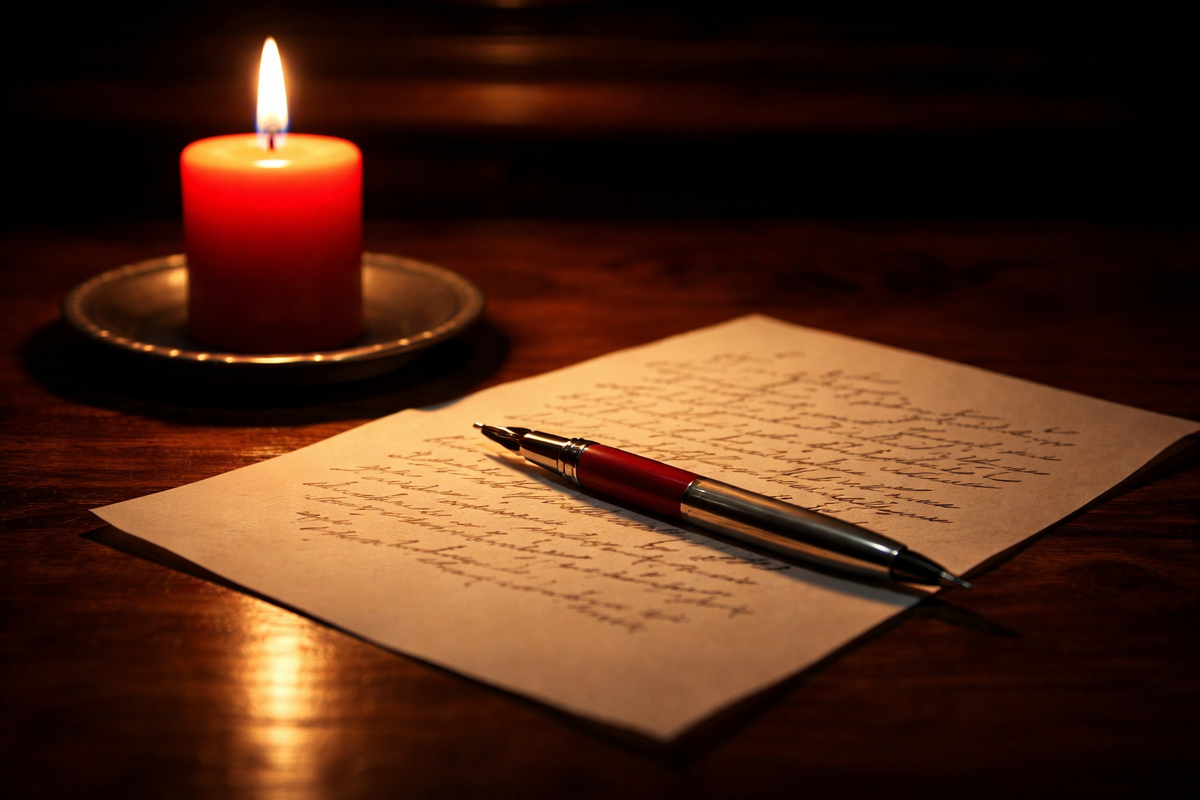
“I shall explain it! I shall pursue it to the bitter end! That’s why I picked up my pen…” said Fyodor Dostoevsky.
My pen had always served the same purpose. Not explaining for others, but for myself, because my struggles carry no less worth than those of others, and I owe it to myself to make sense of them.
That’s when my words began to lose the excitement they once carried with each realisation. I stopped writing for myself and started writing for my audience.
Even I, myself, am bored of whining about my perfectionist father. This is a declaration of discharging him from the blame because blame is avoidance.
Somewhere along the way I lost my courage to ask the right questions.
Blame runs in our family. My poor mother was the one forced to play the black sheep. I remember once dropping an entire shelf on my feet, and with all the pain, I forced myself to walk over to the phone to call my mother and tell her it was her fault for placing the laptop somewhere so uncanny.
Still, behaviourism had always fallen short in explaining the wonder we all carry within.
If B. F. Skinner were alive today, I would ask him,
How can we be certain of who we are if our environment is never the same as it was even from the day before?
If you’re not trapped in Groundhog Day, I assume the answer is, we cannot.
While we call society unjust, we are the ones who are doing the biggest injustice by expecting ‘the self’ to be established once and always remain the same.
It is only now I realise that I do not know who I am, and I find freedom in letting go of the need to arrive at a conclusion.
We crave answers, certainty, to know the outcome at all costs but what does knowing that it will all end with deathr done to us?
“I myself shall live to be 60! I will live to be 70! To be 80! Now wait a moment! Let me get my breath back…” said Dostoevsky as a sick man at forty, inevitably wondering how far he could go while carrying an illness.
Being ill did two things to him. He first reached toward the future, then remembered the urgency of his remaining days, and stopped mid-sentence to catch his breath. Being present is returning to your breath.
Since being diagnosed with Parkinson’s, I have found myself in the same battle as Dostoevsky.
I wanted to live as much as possible while my mind constantly fought to predict the future. By repeatedly estimating outcomes that was never promised, I ended up missing the urgency of living in the present.
I built a life full of motion, leaving no room for rest because staying busy felt like moving forward. Mistaking pressure for purpose while busyness replaced the things that actually mattered.
The productivity trap is avoidance disguised as growth.
My reflections, analysis and structures made the trap harder to detect, because it looked like intelligence. In truth, writing, creating, building something real requires mess, exposure and imperfection.
Since I was a little girl, I repeated the same anthem over and over again.
'I want to make a difference in the world.'
Mahatma Gandhi knew better when he said, “Be the change you want to see in the world.”
I couldn’t.
While I tried to calculate life, I only messed up the equation.
At first, being depressed invited in more freedom.
'I don’t have to go to the gym, I’m depressed.'
'I don’t have to keep up with my tasks, I’m depressed.'
'I might as well get a takeaway, I’m depressed.'
Just like the comfort of being sick; not being obliged to present any form of productivity, leaving you with nothing but lying in bed, watching TV.
It wasn’t the act of doing nothing that invited comfort. It was knowing that I could rest guilt-free.
My problem was never being depressed but allowing myself to rest only when I was depressed.
Slowly, I realised my life had been hijacked by demands. I surrounded myself with “musts,” “needs,” and “shoulds” so blindly, imprisoning myself in my own belief system. Within the structured expectations society places, I still asked for more ways to limit my freedom.
“Man is born free, and everywhere he is in chains,” said Jean-Jacques Rousseau.
Just like I did with my father, I escaped a truth I could not endure, blaming society for what I had forced upon my own essence.
Society didn’t need to restrain me. I learned to do it myself by polishing my chains, calling them identity and ambition by becoming a person shaped around expectations. It appeared as others, and while that isn’t entirely untrue, the outer world is only a reflection of what’s within.
Then life took its toll and threw Parkinson’s my way at the age of 25.
“Every disease is a crystallised form of an inner disorder,” said Stefano Elio D’Anna in The School for Gods.
Before everything happened, balance had always been an issue in my life, living on extremes, either all or none. My healing began with the alignment I reached within, and I owe that to the death of the self that confined me to an identity I was never meant to fixate on.
Over the past few months, I have watched that alignment slip away from my hands, day by day, while nights folded into days and I remained awake outwardly, but asleep within. The world dissolved while I forced myself to stare at the brick walls through the window, memorising each edge. The corner of my L-shaped couch wore thin, yet even that felt stronger than my inner state.
I started living on autopilot, convincing myself I was pursuing success.
It wasn’t the pursuit of success. It was the battle of proving my worth to someone else.
Following my declaration of depression, in a moment no less random than this, a voice in my head kept saying, “You’re lost, no one will choose you, you don’t have a life, you’ll never make it,” finally found its face.
I didn’t realise how much impact the words from my ex had.
It all stitched itself into place when my thumbs began to write this message, and my muscles finally relaxed.
20.03.2026
I don’t know how much this matters to you, but that doesn’t matter to me.
I’m doing this for myself.
When you said, “ You don’t have a life, you will never be chosen, never truly loved, you don’t even have the mental capacity to hold together your own 1+1, everyone has turned their back on you, you are lost,” it stayed with me more deeply than I expected.
Without realising it, proving you wrong replaced itself as a subconscious motivation. I kept pushing myself more and more and more but in truth, I wasn't trying to prove myself to you. I was trying to prove it to myself. And while I tried to do that, the opposite happened.
I lost myself even more.
I threw myself into Substack. I ignored my own needs. And eventually, I found myself in the middle of a depression that began to consume everything I once loved about who I was.
Maybe you’ll find happiness in knowing how unhappy I am, I don’t know. But you have been on my mind for a while, and I kept asking myself, ‘why?’
At first, I thought I missed you, because that is something that comes easily to me, despite everything.
Just like my habit of deceiving myself.
Now I understand that it was my nervous system reminding me of your words, and that became one of the points where I started to destroy myself.
Yes, no one will choose me. Because I didn’t know what it meant to choose myself.
Thank you for showing me this.
I’m not sending this to come back into your life. I’m sending it because I owed these words to myself.
From here on, I will continue my path by trying to learn what it means to choose myself. I would be lying if I said I have everything figured out or that I have made peace with all my struggles. I haven’t. But I am still trying, and I know I am strong enough now to stand bare and say I do not have the answers.
If I learned one thing from my biggest rupture, it’s that certainty can be far more terrifying than uncertainty.
The destination is known, but the living in between is mine.
Being depressed isn’t the end game. It is the beginning that marks the collapse of old structures.
For days, I opened my eyes in silence, and something shifted into calm, disconnecting from the world, blissful and gentle.
I now have the courage to admit that there’s no luminous light awaiting at the end of the road.
I place my trust in what I cannot yet see, slowly taking shape not escaping darkness, but loving it enough to see the light inside.
To live is not to demand the ending, but to have the courage to keep writing in the dark.
That is why I picked up my pen.
I read every comment. I may not be able to respond to all of them, but I cherish each of them more than you know. I’m still taking things slowly, but these words asked to be shared.
Thanks for reading! This post is public so feel free to share it.