The Law of the Mirror
We are being judged because we are the judges.
Author’s note:
This piece was formerly published as a guest post on another Substack publication that’s been inactivated. I’m publishing it here now, in its rightful home. A text about mirrors deserves to choose its own reflection. Some ideas circle until they find the place they were meant to speak from.
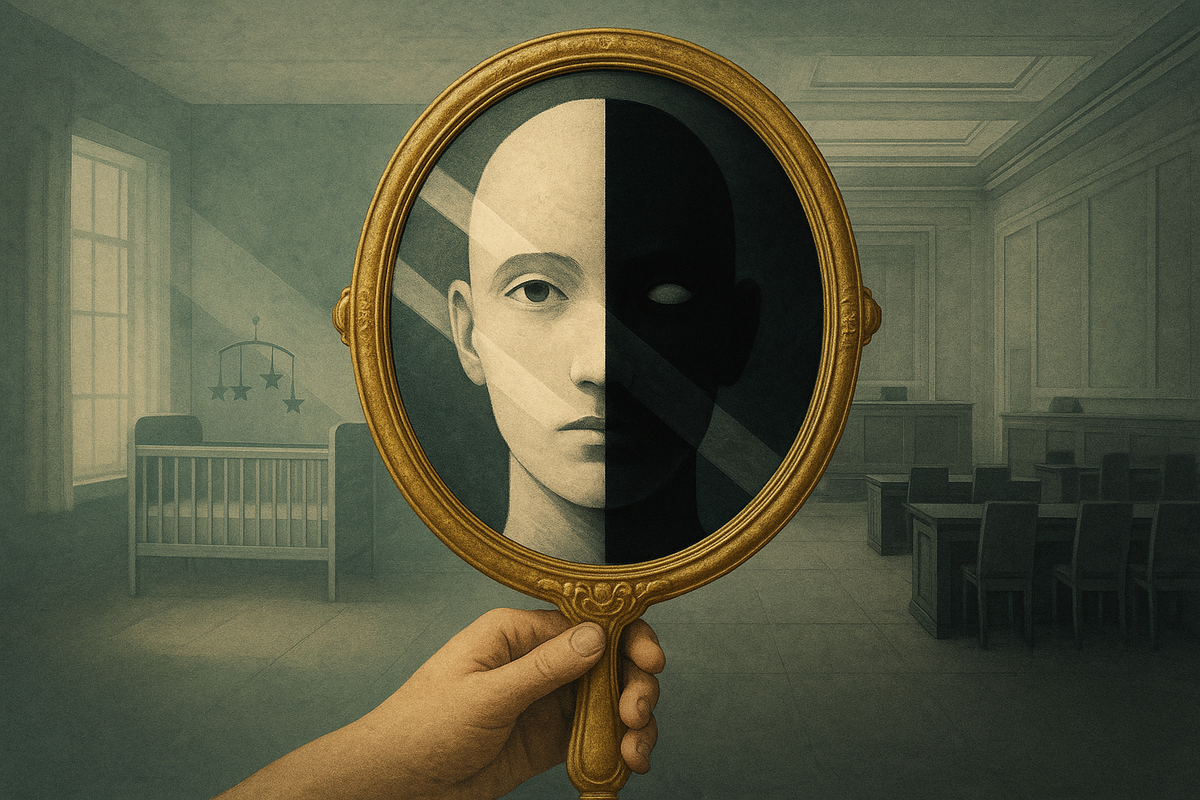
Imagine being told you were nothing more than a blank slate, no soul, no essence, just reflexes. That is Behaviourism. I have always found it at odds with life.
We enter the world as tiny beings without grudges, envy, or hatred. This is what John Watson and B.F. Skinner would call tabula rasa in action: the mind as a blank slate. To them, there are no inborn ideas of malice or virtue, no moral compass pointing toward good or evil, just a bundle of reflexes, needs, and raw potential.
In this view, even the most infamous figures in history, yes, even Hitler, began life this way. At birth, there was no ideology in his head, no grand scheme of destruction; only the helpless dependency every infant knows. He was not destined to be who he became; he was shaped. Behaviourism resists the temptation to cry “born evil.” Instead, it whispers: show me the stimuli, show me the consequences.
Still, I don’t believe that only behaviours could shape our scope of life. The stories of identical twins, separated at birth, who grow up in different worlds yet still mirror each other in surprising ways… Some things we carry from the very start, stay with us quietly, shaping who we grow into.
Yet I found it fascinating to witness how much the world influences who we become.
For me, my sisters had the biggest influence, for better and worse. Being born a decade after them, I always wanted to catch up; I was furious with my mother for not giving birth to me earlier. I would have been given the birthright to join my sisters’ so-called girls’ club.
That longing to belong shaped me in ways I didn’t understand at the time. As a child, I could never lie. It seemed absurd to surrender my credibility in someone else’s eyes. Words have always been the core of my strength, so to give someone a reason to doubt me felt like the most profound rupture in my power.
That was my first existential dilemma. My need for belonging and the desire to protect my authentic self clashed.
In the end, my sisters kept me out of their club, convinced I would reveal their secrets that felt monumental then, even if they were trivial in truth.
The burden of having to prove myself never came with ease. To my sisters, I had to prove loyalty; to myself, I had to prove I was worthy of belonging.
I failed in both.